When you are going through the transformation from being an employee or a solo-practitioner to a thriving business owner, one of the toughest things to master is Leverage.
Those who successfully embrace Leverage, become true business owners. Others, remain stuck underneath a glass ceiling where you continue to trade time for money.
In order for your business to generate $3M, $5M, $10M, $100M, and even $1Bn of revenue, you have to find a way to re-wire yourself and embrace leverage. I’ll be honest. I struggled with this in my own life. Being an immigrant, being someone that takes pride in hard work, it was hard for me to find a way to get out of my own way.
In this essay, I’m going to share my own understanding of Leverage, explore why I avoided Leverage, and then finally share how I broke through.
The 3 Types of Leverage
Imagine this for a moment. You encounter a health scare. You’re hospitalized. No laptop, no iPad, no Phone, barely any consciousness. You learn that it’ll all be fine, your family is there to support you, but you have absolutely zero room to work. It’ll take three months until you can return to work.
During that 3-month period, your business doesn’t flinch. It continues to compound cash, it continues to deliver outcomes for your customers and clients. And everything runs like clockwork. You don’t have to worry about money. Everything hums.
Why? Because this version of you embraced Leverage years ago. And you built a business. Here are the three forms of Leverage you embraced:
1. Human You happen to do 12 things in your business. And you’re pretty great at all of them. But you got smart. You realized that the average human can’t do all 12. So you broke down the 12 things into 3 distinct roles, and you hired Humans better than you at doing those three specific roles. They built out teams underneath them, they built out systems, robots, everything. And you no longer had to do 11 out of those 12 things since then.
2. Systems Between you and the Humans you hired, you embraced Systems. This includes software platforms, AI, standard operating procedures, checklists, spreadsheets, and even just plain old fashioned email. You didn’t stop there. The Humans you hired embraced Marketing, Sales and Customer Success systems. This gave those Humans Leverage of their own.
3. Capital When it was just you, you had profits. You took those profits and invested in Humans and Systems. That was using Capital as Leverage. That was your first step, that led to more and more compounding Leverage. Investing in Humans and Systems in time generated more profits. You used those profits (read: Capital) to invest more into your Marketing Systems, your Sales Systems, your Customer Success Systems, and Humans (read: Profit Sharing). This in turn created more Capital. The cycle continued.
All three of these forces of Leverage worked together to create a perpetual motion machine. You unlocked the Flywheel of Growth. The one thing you kept owning out of those 12? Allocating Capital, and even that started to get its own System.
What Stops You From Leverage
Now let’s suppose for a moment this hypothetical moment of you in the hospital for 3-months wasn’t forced on you. Let’s imagine instead, you faced the possibility that the business ran on its own, and it didn’t need you, and you had nothing to do, you just had to sit tight and enjoy the rewards.
How would that make you feel?
Yeah exactly, that uncomfortable feeling at the pit of your stomach that you just felt as you read this is a direct reason why you stop yourself from embracing Leverage.
Whether we’re likely to admit to it or not, a huge part of our identity as Entrepreneurs is being the savior for our business and our customers. “Only me, can do this. Only me, cares this much. Only my brilliance, can deliver these outcomes.”
And yes that’s true. Only you, can do all 12 of those things. But when you have Human, Systems, and Capital Leverage working on those 12 things? You don’t stand a chance. They’ll outpace you, they’ll out-deliver you, they’ll out-deliver you, and believe it or not, your Customers will love you more for it, because they’ll like their results that much better.
Crazy right? But that leaves us with the original problem. Faced with an emergency and a health scare, you’d be glad for Leverage. But faced with a much lighter calendar, your Ego kicks in. The way you find fulfillment is by doing. In order to embrace Leverage, you have to find a way to find fulfillment in new exciting ways.
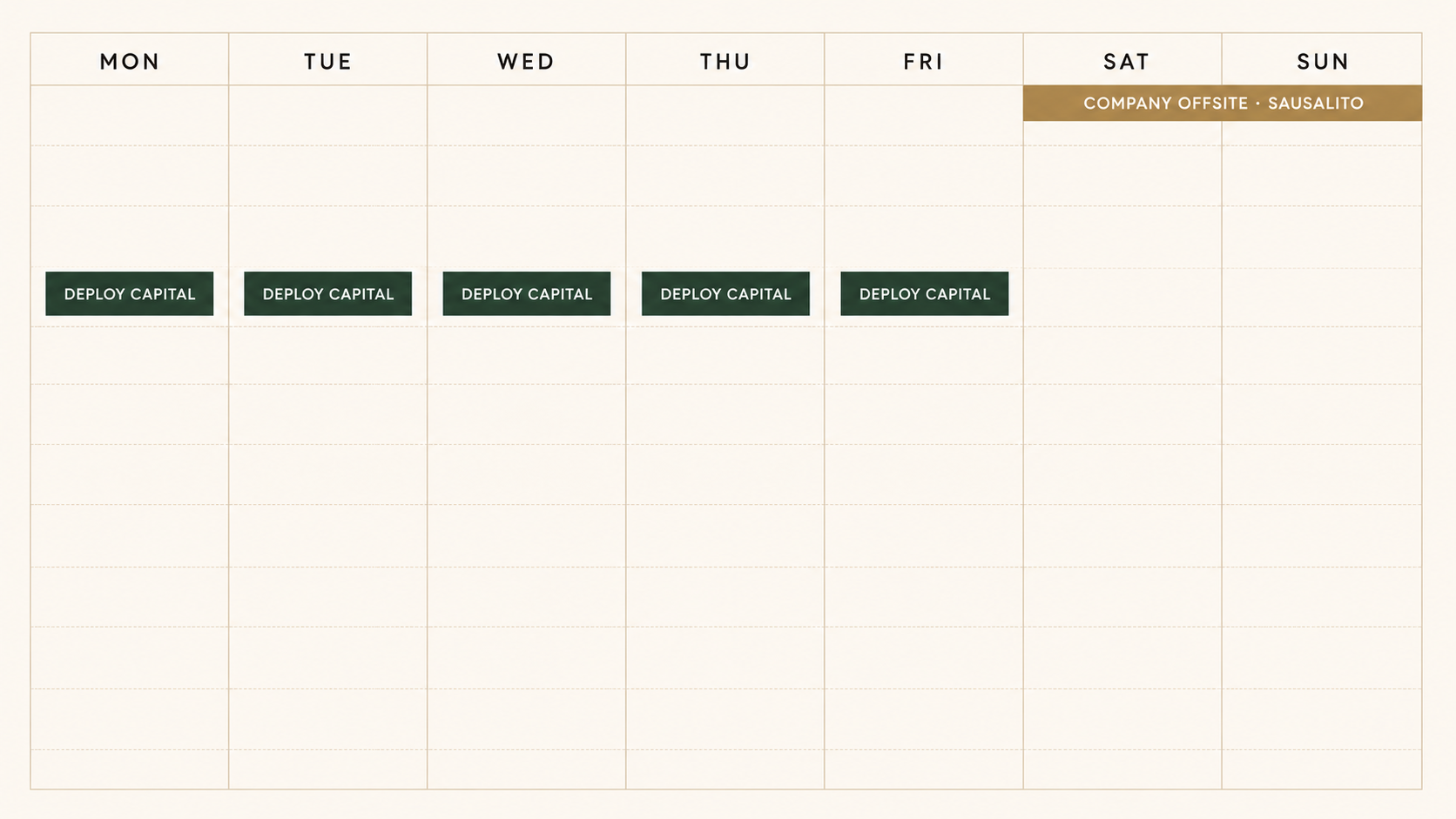
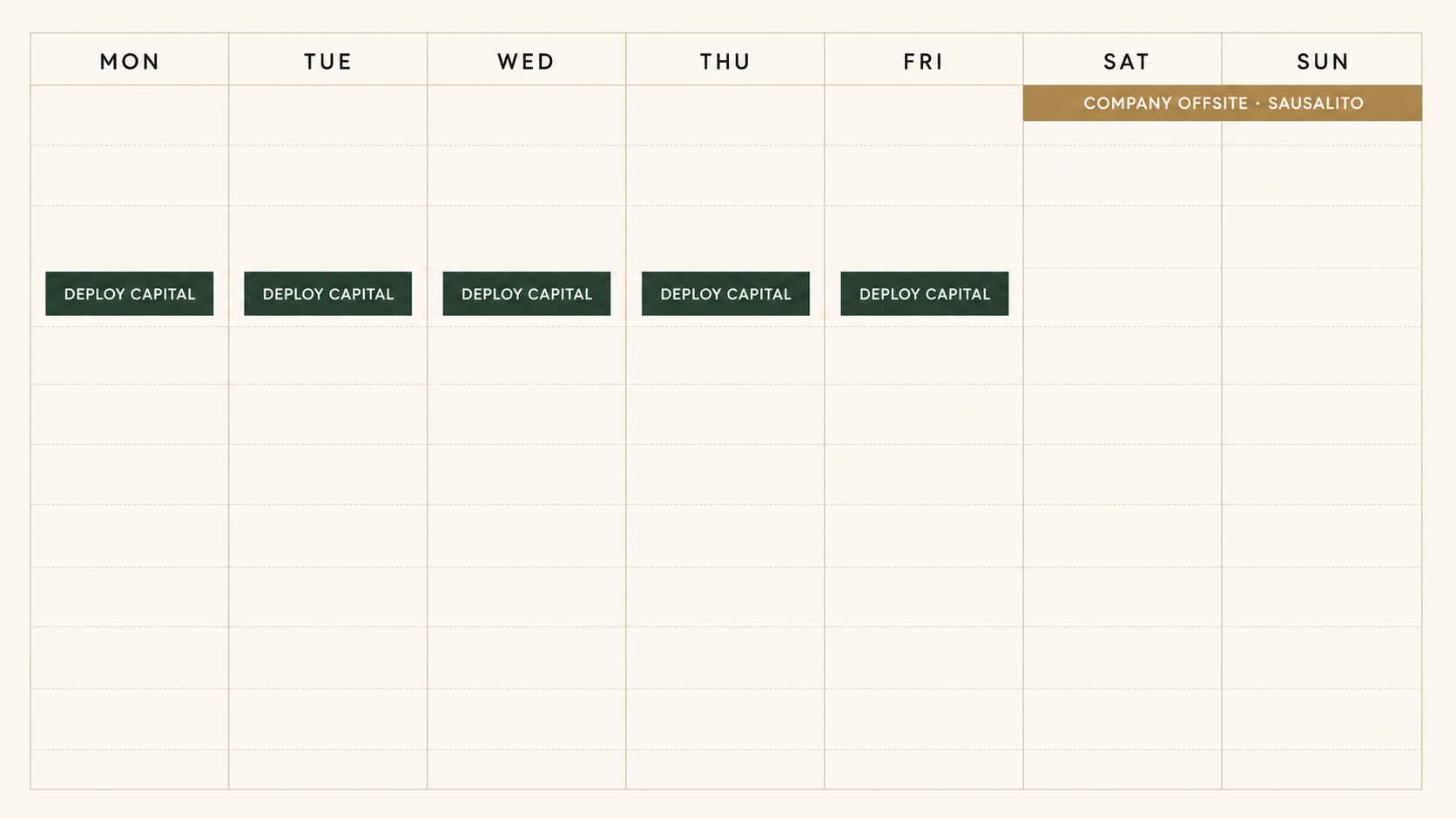
I remember when I sold my company ToutApp. I was grabbing drinks with my board member and old friend Greg Gretsch. He asked, “What’re you going to do now?” I said, I’m not sure. My calendar is empty. We’ll see.
“The calendar always finds a way of getting filled up. You’ll be surprised how your days get filled.” — and it did. The same will be true for you. You’ll find new passions, new projects, except it’ll be built on a profitable foundation. Don’t let that empty calendar scare you. Embrace it. Embrace Leverage.
Why Leverage Gets a Bad Rep
There’s got to be a catch to all this right? We hear about Founders coming back to flailing companies. We see Founders manufacturing a crisis just so they can find a reason to swoop back in and “save the day.”
Those are the edge cases. The majority case? Founders who turn into Owners and thrive in their businesses. They escape 80-hour weeks and an impossible job that leads to burnout, and they get thriving businesses.
And best of all? They find new ways of expanding the business: new product offerings, new ventures, investments, and a higher quality of life. So when you think of the excuses that stop you from embracing Leverage, catch the excuses, catch the bad advice, catch the false promises of 996 that even the VCs sell you.
The 3 Steps to Embrace Leverage
I’ve struggled with this in my own life. My ego got in the way. My desire for fulfillment stopped me from turning my “startup” into a “Business.” But I found a way to break through. Here are the three steps I followed:
- Create a list of all the things you do in your business
- Map it to distinct roles with really great Humans that do just a subset of those things really well. These are specialists not generalists, usually spanning across Marketing, Sales, Customer Success, Customer Support, and Engineering.
- Map out the Systems that need to exist that you can build or Humans can build so that the core of your business predictably and consistently delivers the outcomes you promise for your Clients/Customers.
- Start with one pillar at a time, and put in the Humans and Systems. Each of these should remove things from your To-Do list and your Calendar. Get used to the empty space in your calendar.
- At first, you’ll have less Capital and Profits because you’re investing in Leverage. This is the standard J-Curve in transforming a business for the next stage of growth. Find a way to stick it through and then you’ll start to get more Capital. Then your job becomes deploying more Capital as Leverage.
- From my experience, start with Customer Success and Support. Then Marketing, then Sales, and then finally Engineering (usually because that is the most expensive).
In Conclusion
Ultimately, this comes down to your Duty. If you’ve got a great Product/Service that your Clients/Customers love, then it is your Duty to deliver successful outcomes to the entirety of your market.
Don’t be selfish. It is your Duty to scale your business. Because if you don’t, your lesser Competitors will deliver a sub-par outcome to your Customers. Your future Clients/Customers will be forced to choose your lesser competitors. All because you were too Selfish and had too much of an Ego to embrace Leverage and scale your business.
This is tough. Few make the transition. But when you do, you have greater impact in the lives of your customers. And, you’ll have greater impact in your own life, your family’s life and those that depend on you. And ultimately? That level of impact is why you started in this in the first place.